






There is a category of wellness practice that ambitious women dismiss before they have tried it, and the dismissal is always the same. Too small. Not serious enough. Not proportionate to the scale of what they are carrying. Not the kind of intervention that would make a real difference to a real problem.
The problem is real. The problem is often enormous. And the answer they are waiting for is going to match the scale of it. Something that requires discipline and structure and measurable outcomes. Something that can be put in the calendar and assessed for effectiveness. Something that earns the name intervention.
Meanwhile, the small thing sits there being dismissed. Doing its quiet work on no one, because no one has allowed it to.
—
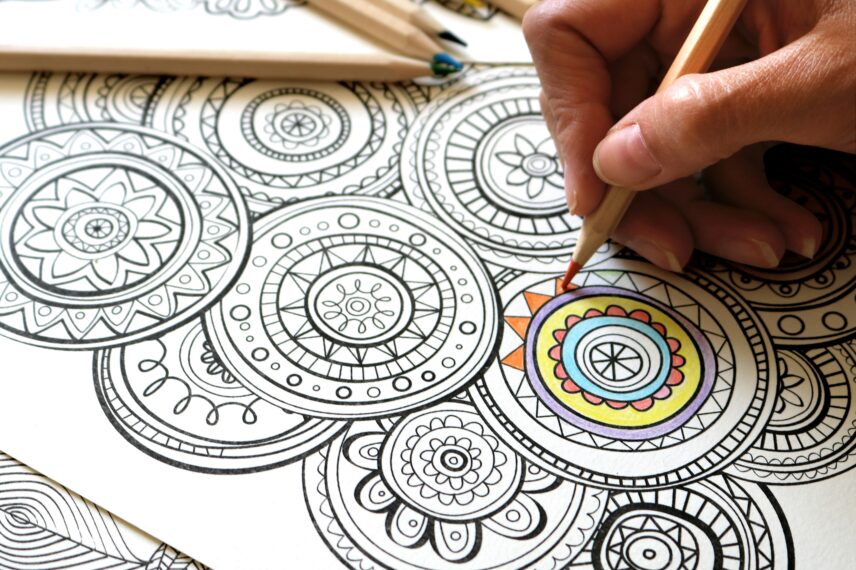
I want to talk about colouring.
Specifically I want to talk about the specific audacity required to recommend adult colouring books in a serious conversation about mental health, because the eye-roll is real and I have felt it and I am recommending them anyway.
The amygdala is the structure in the brain most centrally involved in generating the stress response. It is the alarm system. When it activates, the body mobilises: heart rate increases, cortisol rises, attention narrows to the perceived threat. This activation is essential in acute danger. In chronic low-level stress, which is the kind most people who need a wellness practice are living with, the amygdala is activated more often than is necessary and with more intensity than the situations warrant. The alarm is too sensitive. It fires too often. And every firing costs something.
During sustained colouring, amygdala activity measurably reduces. This is visible on imaging. It is not a perception or a placebo. The reduction is similar in magnitude to what occurs during meditation, which is why colouring is sometimes described as an accessible form of meditation for people who find formal meditation difficult. The hand is occupied, which handles the fidgeting impulse that derails many meditation attempts. The eyes are focused on something contained and visually interesting, which provides the directed attention that prevents the mind from going immediately to the running commentary about everything that still needs to be done.
The result is a mild flow state. Not the deep flow of a skilled creative practitioner in the middle of their best work. A mild flow that is available to almost anyone who commits to the practice for long enough to stop thinking about whether it is working.
I bought a botanical colouring book during a season when my mind would not stop in the evenings. Not a hard season by external measures. Just a season of sustained noise inside my head. The kind that makes the transition into sleep difficult because the mind is still processing, still rehearsing, still working through things that do not need to be worked through at 11pm.
I coloured for forty minutes before bed every night for three weeks. I did not do anything else. I put my phone in another room and I sat with the colouring book and the pencils and I coloured. By the end of the first week I was sleeping better. By the end of three weeks the night noise had significantly reduced in both volume and frequency. I did not understand it. I did not need to understand it. I just knew it was working.
—
Silence is the other one.
We have filled every quiet moment now. Not because we prefer noise to silence, though some of us do, but because silence has become associated with emptiness and emptiness has become associated with waste. There is always something available to fill the gap. A podcast, a playlist, a video, a scroll through whatever the algorithm has assembled for this particular Tuesday afternoon. The gap is never empty for long because we have an infinite supply of things designed to fill it.
But silence is where the nervous system finally exhales. It is where the activation that has been building all day gets a chance to dissipate rather than being immediately replaced by more input. It is where the thoughts that have been trying to surface but have not found a gap finally arrive. It is where creativity lives, in the neurological sense: the default mode network, which is the brain network associated with imagination, self-reflection, and the integration of experience, activates most fully when external input is reduced.
The ambitious woman who is never silent is the ambitious woman who is also never quite as creative or as clear or as connected to her own thinking as she could be. Not because she is not intelligent. Because intelligence needs quiet to organise itself into insight. And she has not been giving it the quiet.
Twenty minutes of genuine silence, not silence while doing something else, not silence with something ambient playing, just deliberate, intentional, chosen silence, does something to the quality of the rest of the day that accumulates over time. The first few times it feels uncomfortable. The mind, unaccustomed to the absence of input, goes looking for something to hold. That restlessness is information. It is telling you how long it has been since your mind had nothing to reach for.
—
A slow walk. Making tea properly. Sitting in a patch of sunlight for ten minutes with nothing open.
These will not fix a crisis. They are not designed to fix a crisis. A crisis requires the appropriate response to a crisis. What these small things do is prevent the accumulation of the minor depletions that compound, over months, into the conditions for a crisis. They are the regular maintenance that keeps the larger system from deteriorating to the point where intervention is required.
The ambitious woman does not do maintenance. She waits until something breaks and then she repairs it. She applies the same approach to her nervous system that she applies to her car: ignore it until the warning light comes on, then fix it, then ignore it again. The result, predictably, is a life spent in cycles of depletion and recovery rather than a life in which the depletion never quite reaches the level that requires the recovery.
The small things are not beneath you. They are proportionate to the actual problem, which is not a crisis requiring a crisis response but a system requiring regular maintenance.
Let them do their work. They have been waiting patiently for you to stop dismissing them.